



Soil Colour as a Indicator of Erosions Risk on an Overburden Material at Greenbushes Mine in Western Australia
School of Earth and Geographical Sciences, The University of Western Australia, M087, 35 Stirling Highway, Crawley WA 6009
Field measurements of soil erosion can be expensive and in many cases impractical. Surrogate, simpler to measure variables, may be used instead to predict erosion risk. As soil structural stability is influenced by a number of soil properties, erosion risk surrogate variables should encompass a number of these influential soil properties. Soil colour and a modified modulus of rupture method were related to field assessed soil erosion, modelled soil losses from the Water Erosion Prediction Project and basic soil properties of overburden material at Sons of Gwalia, Greenbushes mine (south-west Australia). The significant relationships found with changing soil colour, modulus of rupture, iron content, sand and rock content explain why soil colour is a possible indicator of erosion risk. The results of this study advocate the potential for soil colour and modulus of rupture to be used as predictors of soil stability, which in turn may provide a powerful management tool.
Key Words
Soil colour, modulus of rupture, erodibility, sodicity, mine rehabilitation.
Introduction
Management of soil erosion is important in the mining industry for mine rehabilitation success. Erosion in mine rehabilitation is a problem as mining companies often attempt to rehabilitate with sodic sub-soils which have extremely poor physical conditions (Valzano et al., 2001). As field measurements of soil erosion can be expensive and in many cases impractical, scientists have attempted to correlate various soil properties to soil erodibility. However, the effect one basic soil property has on soil erodibility depends on other soil properties. For example, the effect sodicity has on physical properties relevant for infiltration and erosion varies with other basic soil properties such as electrolyte concentration, soil texture and soil mineralogy (So and Aylmore, 1993). For this reason, sodicity alone may be a poor predictor for hydrological soil response. However, surrogate soil erodibility indicators that encompass a number of soil properties may be better predictors of physical properties relevant to infiltration and erosion.
Two measurements, encompassing a number of basic soil properties are soil colour and modulus of rupture. Soil colour, as a function of parent material, may also encompass properties such as texture, mineralogy and iron content (Schwertmann, 1993; Trott and Singer, 1983; Romkens et al, 1977). As soil loss may be determined by the strength of the sodic regolith (Levy et al., 1998), an alternate surrogate variable that encompasses a number of soil properties may be modulus of rupture. Therefore, the objective of this study was to evaluate the use of a simplified modulus of rupture procedure and soil colour as better indicators for soil erosion risk than basic soil properties on a sodic overburden at Sons of Gwalia, Greenbushes mine (south-west Australia).
Methods
The Greenbushes operations require removal of a weathered greenstone clay in order to access the mineral bearing weathered pegmatite (Bennison, 1978). This overburden material is used as the primary rehabilitation medium over waste rock dumps. The study site was located on an area of Floydes Waste dump (50 m down slope and 210 m wide) where 0.5 m of overburden material had been placed over the waste rocks and then ripped on the contour.
Soil samples were then taken from the surface overburden (top 10 cm) across the plot in 5 transects of 20 with each sample being labelled as brown, light brown or white according to the human eye. Soil samples were air dried and examined in the laboratory for percentage rock content. The resultant < 2 mm fractions of transects 1, 3 and 5 were then used in soil characterization analysis. This included measuring electrical conductivity (McArthur, 1991), pH (H2O) (McArthur, 1991), soil texture using the pipette method outlined in Day (1965) and sampling times estimated by Loveday (1974), organic matter content using the Walkley-Black wet oxidation method detailed in Rayment and Higginson (1992), cation exchange capacity (Blackmore et al., 1987), exchangeable sodium percentage (Blackmore et al., 1987), iron (Fe2O3) content using X-ray Florescence Analysis (Jones, 1991) of transect 3 and mineralogy of transect 3 using an X-ray diffractometer. The hydraulic conductivity was adapted from Klute and Dirkson (1986) using the undisturbed soil cores. A piece of Nytal mesh was placed at the bottom of the core sample and another empty brass cylinder core was attached to the top of the core sample using Parafilm and masking tape to create a water tight seal. The saturated soil cores were then weighed and placed in an oven at 105°C for 2 weeks to dry. The dry soil and cores were then weighed, and the bulk density calculated from the weight of this dry soil / volume of the core.
The modulus of rupture procedure (Richards 1953, 1954 and Reeve, 1965) was modified to use circular moulds being 2 cm in diameter and 3 cm deep (Figure 1). Readings from a hand held pentrometer, using the 1.5 cm and 0.5 cm head were converted to mega Pascals using equations 1 and 2 respectively.
Reading in MPa = (measurement * 21.4) + 10.5 |
(1) |
Reading in MPa = (measurement * 75) + 11.1 |
(2) |
Two different methods of soil colour measurements were made. Firstly, digital photographs were taken of the modulus of rupture trays in a controlled lighting room (dark room) using a Sony digital still camera DSC-P3. The camera was set on automatic focus, no flash, indoor white balance, the spot meter off, 200 iso film speed, an image size of 1920*1440, fine quality, TIFF mode and zero sharpness. Photos were taken from various distances of single trays holding 12 moulds to trays holding 4 of these 12 mould trays at different rotations. The camera images were then transferred onto the computer. A circular area (3.2 cm2) of each mould was selected and analysed using Image J computer program (Rasband, 2003) for the average, standard deviation, minimum and maximum measurements of the red, green, blue and red, green, blue grayscale values. Hue, saturation and brightness from a red, green, blue stack were also measured. When taking the photos, the positions of the trays were rotated to test the reproducibility of this procedure.
Further soil colour testing was done using a chroma meter CR-310, CIE-L*a*b colour scale. Air-dried soil samples were placed in the granular-materials attachment Cr – A50. The chroma meter 310 uses a wide area illumination, with 0° viewing angle geometry to obtain readings that correlate well with colour as seen under average daylight. A pulsed xenon arc lamp inside a mixing chamber provides diffuse, even lighting over the 50 mm diameter measuring area. The chroma meter CR-310 was calibrated using the CR-A44 calibration plate, with Y = 93.50, x = .3114, y = .3190. For further information on the operation of this device see the Minolta Chroma meter (CR-300/CR-310/Cr-321/CR-331/CR-331C) Instruction Manual.
The positions and size of erosion rills were measured along 6 transects starting at 5, 10, 15, 20, 25, 35 and 45 metres down the slope of the trial site after 437 mm of rainfall over 4 months. These results were tabulated into rill frequency, average volume (width * depth * length * 0.5) and soil loss per area (volume/area) for three different soil colours (brown, pale brown and white).They were used to calibrate the WEPP model and to gain an idea of where the most erosion was occurring.
The hill-slope component of the Water Erosion Prediction Project (WEPP) model (USDA, 1999) was used to produce estimates of soil losses from a single storm event (152.4 mm for 2 hours with a maximum intensity of 76.96 mm h-1) for the overburden material and how these change with the variations in the overburden soil properties. A user defined hydraulic conductivity of 6 mm h-1 was used with model derived rill and interill erodibility and critical shear stress. A simple linear design was chosen with a slope length of 50 m slope and a slope steepness of 10%. Land use was modelled to simulate a bare soil with contour ripping (contour height = 0.5 m and distance between contours 2 m).
A matrix of correlation coefficients between the soil properties measured in the overburden characterisation was obtained using an Excel (1998) data analysis toolpak. The significance of each correlation coefficient was tested using the regression option of the analysis toolpak and comparing the two sets of variation. A regression tree analysis was done using the same data in S Plus 6.1. The modelled soil loss data was also analysed using Excel (1998) data analysis toolpak using a t-test to determine if the results from brown, pale brown and white were statistically different.
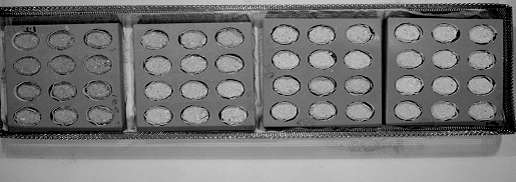
Figure 1: Four modulus of rupture trays with each circle representing the area used for Image J analysis.
Results
The overburden at Greenbushes varies in its physical and chemical properties. The overburden was dominantly quartz (35 – 45%) and kaolinite (35 – 60%). Its texture ranged from a loamy sand to a clay loam, modulus of rupture ranged from 33 MPa to 139 MPa and exchangeable sodium percentage from 18 to 63.
Saturation from the hue, saturation, brightness (HSB) colour scale was the most compatible image analysis measurement with human perceptions (field observations) of colour change. With “brown” being greater than 170, “pale brown” being between 111 – 170 and white being less than 111. The colour saturation measurements on photos of 4 trays with 12 samples had a reproducibility of r2 = 0.90.
The a (redness) index from the CIE-L*a*b colour scale measured with the chromo meter had the closest match with saturation from the hue, saturation, brightness colour scale; r2 = 0.83,
a = 0.07*saturation – 6.2.
Rills and interills occurred across the trial site where modulus of rupture values were higher and saturation from the hue, saturation, brightness colour scale was lower (whiter overburden). See figure 2.
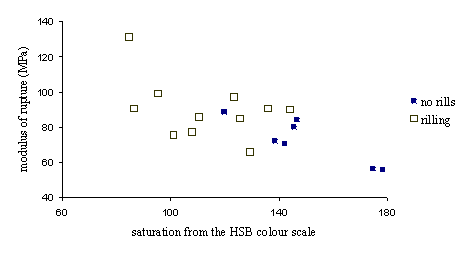
Figure 2: The occurrence of rills and interills in relation to modulus of rupture (MPa) and saturation from the hue, saturation, brightness colour scale in the Greenbushes trial site.
Some of these variations in soil properties can be related to other soil properties. Table 1 is a correlation matrix, presenting the correlation coefficients between the measured soil properties of the Greenbushes overburden (transect 3). Colour saturation from the HSB colour scale increases significantly with increasing percentage iron content ( P < 0.001), increasing sand content (P < 0.01) and increasing rock content ( P < 0.05). Redness (a) from the CIE-L*a*b colour scale also increases significantly with increases in percentage iron content (P < 0.001) and increases in sand content (P < 0.01).Modulus of rupture significantly decrease with increases in saturation from the hue, saturation, brightness colour scale (P < 0.001), increases in percentage iron content (P < 0.01) and increases in percentage sand (P < 0.01). Exchangeable sodium percentage increases significantly with increasing electrical conductivity (P < 0.001), iron content (P < 0.001) and colour saturation (P < 0.01).
Table 1: Correlation matrix and their significance between measured soil properties of the Greenbushes overburden
Properties |
colour saturation |
redness (a) |
clay |
silt |
sand |
rock |
MOR |
soil detachment |
EC |
pH |
ESP |
Fe2O3 |
colour saturation |
1 |
|
|
|
|
|
|
|
|
|
|
|
redness (a) |
0.66** |
1 |
| |||||||||
clay |
-0.36 |
-0.52* |
1 |
| ||||||||
silt |
-0.59* |
-0.40 |
0.01 |
1 |
| |||||||
sand |
0.68** |
0.64** |
-0.64** |
-0.78*** |
1 |
| ||||||
rock |
0.57* |
0.18 |
-0.23 |
-0.40 |
0.45* |
1 |
| |||||
MOR |
-0.72*** |
-0.41* |
0.23 |
0.61** |
-0.61** |
-0.49* |
1 |
| ||||
soil detachment |
0.28 |
0.10 |
-0.10 |
0.00 |
0.06 |
0.26 |
-0.30 |
1 |
| |||
EC |
0.59* |
0.55* |
-0.43* |
0.11 |
0.18 |
0.29 |
-0.31 |
0.49* |
1 |
| ||
pH |
-0.26 |
-0.35 |
0.32 |
-0.16 |
-0.08 |
-0.02 |
-0.06 |
-0.17 |
-0.46* |
1 |
| |
ESP |
0.68** |
0.66** |
-0.58* |
-0.11 |
0.45* |
0.44* |
-0.46* |
0.42* |
0.94*** |
-0.44* |
1 |
|
Fe2O3 % |
0.78*** |
0.71*** |
-0.37 |
-0.31 |
0.47* |
0.65** |
-0.63** |
0.33 |
0.73*** |
-0.22 |
0.81*** |
1 |
*P < 0.05, ** P < 0.01, *** P < 0.001
MOR = modulus of rupture
EC = electrical conductivity
ESP = exchangeable sodium percentage
A regression tree analysis of the modelled soil losses showed that nonlinear variability may be occurring in the model soil loss data due to rock content. Removal of the seven data points where rock content was greater than 9.8 % showed that modelled soil losses from the white overburden (colour saturation < 111) was significantly higher (P = 0.012) than modelled soil losses from the brown overburden (colour saturation > 170).

Figure 3: Regression tree analysis of WEPP modelled soil loss with sand, silt, clay, rock, MOR, EC, ESP, saturation, a (redness) and observed colour were the independent variables (53 data points).

Figure 4: WEPP modeled soil losses (samples with rock > 9.8 removed) grouped into colour classes brown, pale brown and white.
Discussion
Soil colour saturation was the best indicator of colour change using image analysis for the Greenbushes overburden and corresponded strongly to field human classifications of “brown”, “pale brown” and “white”. The reason why red, green, blue values did not correspond to the visual changes in the overburden material may be because these are non-linear with human perception (Ford and Roberts, 1998). The hue and brightness values from the hue, saturation, brightness colour scale showed little variation between what visually appeared to be distinct colour differences in the overburden material. This may be because hue relates to the quality of colour described by the words red, yellow, green and blue (Ford and Roberts, 1998) and as indicated by the redness (a) values from the CIE-L*a*b colour system, these values were close to zero (white). The brightness relates to the lighting conditions and because the light was not varied these values showed little variation. The saturation, however, showed the most variation between samples and corresponded to changes that could be seen in human perception. Although the hue does not have much variation between samples the change in “browness” humans can see is related to changes in colour saturation. The development of this method means that precise soil colour measurements can be made using accessible equipment that can also be used for things other than just colour measurements.
The way the soil colour relates to individual soil properties can be used to explain why soil colour also relates to soil structural stability and soil loss. Increasing redness (a) and colour saturation relate to increases in iron content, sand content and rock content of the Greenbushes overburden. These relationships follow established trends between increasing iron content and structural stability (Le Bissonais, 1996) and soil erodibility (Romkens et al., 1977; Trott and Singer, 1983). The “whiter” overburden, having higher silt contents also follows established trends of medium textured soils having higher erodibilities (Toy et al., 2002). Increasing rock content has also been related to increasing soil structural stability by protecting the underlying topsoil structure from aggregate breakdown, surface sealing and crusting (Poesen et al., 1994). These relationships support the notions of using colour as an indicator of soil formation established by Schwertmann (1993) and the value of using parent material to predict soil erodibility, established by Trott and Singer (1983). This indicator of soil formation is a potential predictor of soil structure for overburden material sourced deep within the soil profile with negligible amounts of organic matter.
Like colour, modulus of rupture also relates to other soil properties individually and it is these relationships that explain how modulus of rupture influence soil erodiblity. Modulus of rupture increased with decreasing iron and sand contents. These relationships support previous studies on surface seal development. Ben-Hur (1985) noted that soils with 10 – 30% clay were the most susceptible to seal formation. Levy et al. (1998) noted that in soils with clay contents less then 10% the amount of clay available to disperse and clog soil pores is limited and thus seal development is poor. The overburden material at Greenbushes has clay contents predominantly in this 10 – 30% range. The few samples that had modulus of rupture readings below 60 MPa also had clay contents less than 10%. The relationship between iron content and structural stability has already been outlined. Field observations on the occurrence of rills also corresponded to higher modulus of rupture measurements. These results support the hypothesis that modulus of rupture can be used as a soil loss predictor on soils that tend to form a surface seal.
The overburden material at Greenbushes has very high exchangeable sodium percentages (19 – 50%). The exchangeable sodium percentages did not relate to soil erosion or the development of a surface seal (as indicated by modulus of rupture). This supports the hypothesis that exchangeable sodium percentages cannot be used alone in rendering a soil stable or unstable. Exchangeable sodium percentage of the Greenbushes overburden had strong positive relationships between increasing electrical conductivity, increasing iron content and increasing colour saturation. It has already been explained that all three of these properties have positive relationships with structural stability. The influence of these soil properties on the soil structure may be larger than exchangeable sodium percentage and explain why there was not a negative relationship between exchangeable sodium percentage and structural stability.
Where topsoil is not available, the “browner” overburden material should be used in preference to the “whiter” overburden at Sons of Gwalia, Greenbushes. Rehabilitation success could still be limited by the use of this “brown” overburden material and better management options of the overburden material in rehabilitation should be investigated.
This study could be further improved with the establishment of better field soil erodibilities. Such measurements can be made with the results of rainfall simulation trials. Although the WEPP model results allowed us to develop a set of relative soil erodibilities across the trial site to compare the hypothesised soil loss predictors it is only a diagnostic tool with predicted equations based on American agricultural soils, rather than Australian overburdens. Sensitivity of the model to rock content has been noted in other studies using WEPP. Favis-Mortlock and Savabi (1996) noted that without calibration the WEPP estimated soil loss was too high and they related this to the stoniness of their soil.
Conclusion
Soil colour and modulus of rupture can be related to field and modelled soil erodibility of the Greenbushes overburden. The reasons for these relationships are explained by the way these predictors relate to other soil properties measured in the overburden at Greenbushes. Soil colour and modulus of rupture as predictors of soil stability and erosion risk have the potential to be valuable in setting management guidelines, not only for mine rehabilitation, but also for other disruptive and contentious land uses, such as urban development and agriculture.
References
Ben-Hur M., Malik M., Letey J., and Mingelgrin U. (1985) Effect of soil texture and calcium carbonate content on water infiltration in crusted soils as related to water salinity. Irrigation Science, 153: 281-294.
Bennison S. (1978) Rehabilitation of areas affected by mining at Greenbushes, WA, In: Proceedings: Rehabilitation of Mined Lands in Western Australia, Perth.
Blackmore L.C., Searle P.L. and Daly B.K. (1987) Methods for chemical analysis of soils, New Zealand soil Bureau Scientific Report 80.
Day P.R. (1965) Particle fraction standard and particle size analysis, In: Methods of Soil Analysis, Part 1: Physical and Mineralogical Methods, 1st Edition, (Ed. Black C.A.), American Society of Agronomy, Agronomy Series 9: 545-564.
Favis-Mortlock D.T. and Savabi M.R. (1996) Shifts in rates and spatial distributions of soil erosion and deposition under climate change. Advances in Hillslope Processes, (eds. Anderson M.G. and Brooks S.M.), Wiley, Chichester.
Jones A. A. (1991) X-ray Florescence Analysis, In: Soil Analysis Modern Instrumental Techniques second edition, {ed. Smith K.A.), pp. 287-324, Marcel Dekker Inc., New York.
Klute A. and Dirkson C. (1986) Hydraulic conductivity and diffusivity: Laboratory Methods. In: Methods of Soil Analysis, Part 1: Physical and Mineralogical Methods, (ed. Klute A) pp 383-411, American Society of Agronomy: Madison, WI).
Le Bissonnais Y. (1996) Soil characteristics and aggregate stability. In: Soil Erosion, Conservation, and Rehabilitation, (ed Agassi M.), Marcel Dekker Inc., New York.
Levy G.J., Shainberg I., and Miller W.P. (1998) Physical properties of sodic soils. In: Sodic Soils: Distribution, Properties, Management, and Environmental Consequences, (eds. Sumner M.E. and Naidu R.), Oxford University Press, New York.
Loveday J. (1974) Methods for analysis of soil, Slough: Commonwealth Agricultural Bureau.
Minolta (1991) Chroma meter (CR-300/CR-310/Cr-321/CR-331/CR-331C) Instruction Manual, Minolta Co Limited, Japan.
Poesen J.W., Torri D. and Bunte K. (1994) Effects of rock fragments on soil erosion by water at different spatial scales: a review. Catena 23: 141-166.
Rasband W. (2003) ImageJ 1.30v. National Institues of Health, USA. http://rsb.info.nih.gov/ij/
Rayment G.E., and Higginson F.R. (1992) Australian Laboratory Handbook of Soil and Water Chemical Methods, Inkata Press, Australia.
Reeve R.C. (1965) Modulus of rupture. In: Methods of Soil Analysis, (Ed. Black C.A.), pp 466-471, American Society of Agronomy Monograph, no. 9 first edition.
Richards L.A. (1954) Diagnoses and improvement of saline and alkali soils. USDA Handbook, 60, US Govt. Printing Office, Washington DC.
Richards L.A. (1953) Modulus of rupture as an index of crusting of soil. Soil Science Society of America Proceedings, 17:321-323.
Romkens M.J.M., Roth C.B., and Nelson D.W. (1977) Erodibility of selected clay subsoils in relation to physical and chemical properties. Soil Science Society of America Journal, 41: 954-960.
Schwertmann U. (1993) Relations between iron oxides, soil colour and soil formation. Soil Science Society of America Special Publication, 31: 51-71.
So H.B., and Aylmore L.A.G. (1993) How do sodic soils behave? The effects of sodicity on soil physical behaviour. Australian Journal of Soil Research,. 31: 761-778.
Toy T.J., Foster G.R. and Renard K.G. (2002) Soil Erosion: Processes, Prediction, Measurement and Control, John Wiley and Sons Inc., New York.
Trott K.E., and Singer M.J. (1983) Relative erodibility of 20 Calinfornia range and forest soils. Soil Science Society of America Journal, 47: 753-749.
Valzano F.P., Murphy B.W., and Greene R.S.B. (2001) The long-term effects of lime, gypsum and tillage on the physical and chemical properties of a sodic red-brown earth. Australian Journal of Soil Research, 39:1307-1331.
